
Frequently Asked Questions about High-Speed Rail
Answers to the most common questions about high-speed rail in America.
U.S. High Speed Rail (USHSR) is the voice of America's growing high-speed rail industry. Founded in 2009, USHSR mobilizes leading designers, builders, suppliers, project sponsors, public agencies and labor unions to advocate for a nationwide high-speed rail network.
High-speed rail (HSR) refers to electrified, intercity trains that travel on dedicated, grade-separated, sealed guideway infrastructure. Modern high-speed rail systems around the world are designed to allow for sustained speeds of 186 mph or higher.
Our two current modes of transport (highways and aviation) are overloaded. The U.S. transportation system also faces major challenges beyond congested highways and airports, including high energy use, rising emissions, and limited mobility between key regions. High-speed rail offers a uniquely powerful solution. It can move large numbers of people quickly and reliably, reduce dependence on oil, lower carbon emissions, enable new economic growth, and connect communities in ways that driving or flying cannot. It offers travelers another option that is convenient, reliable, comfortable, inexpensive and many times faster than cars or short-hop flights.
High-speed rail creates millions of new employment opportunities across construction, manufacturing, engineering, station operations, real-estate development and supply chains. Beyond jobs, high-speed rail stimulates economic growth through smarter, higher-density land use, improved connectivity, and expanded labor markets. Plus, it does so while delivering new mobility and transport capacity. And it makes traveling easy and fun. Visit our benefits page to learn more.
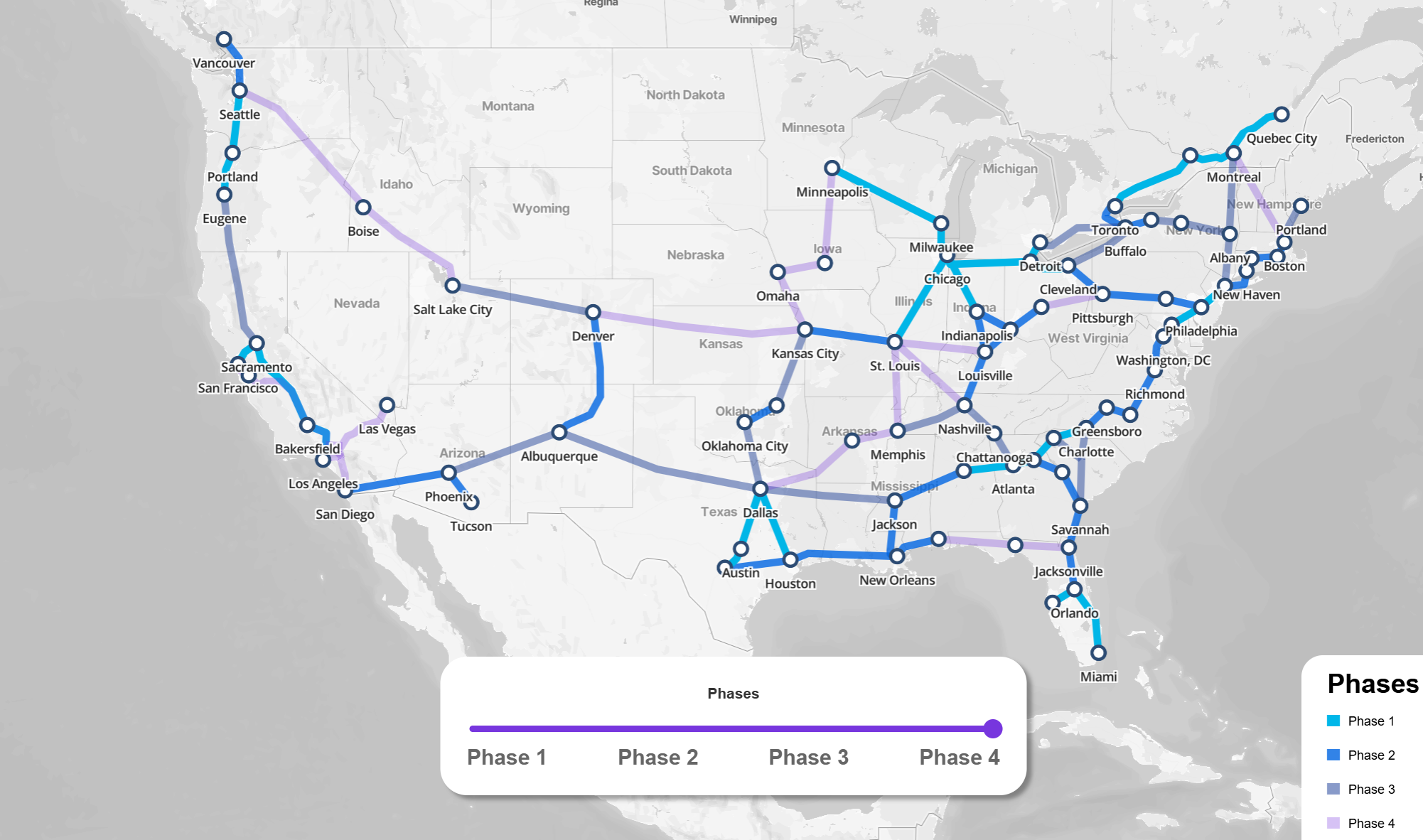
Several major corridors are in motion across America, reflecting both current construction and planning stages. We highlight projects in different stages of development across the country. Each represents a significant opportunity to demonstrate world-class high-speed rail in the U.S.
A national high-speed rail network would be powered by electricity, ideally from a mix of zero emissions sources, and would shift travel away from energy and materials-intensive cars and airplanes. This means lower carbon emissions, reduced oil dependency, fewer pollutants and a stronger path toward sustainable mobility for the country.
Trip time refers only to the duration spent onboard a train, plane, or car while it’s in motion. Door-to-door time includes the entire journey. That includes the time at which you leave your home all the way to the time when you arrive at your final destination. That means accounting for driving to the airport or station, parking, check-in, waiting, transfers, and local travel at the other end.
High-speed rail dramatically reduces door-to-door time because stations are centrally located, check-in is fast, and connections are seamless, giving passengers back valuable hours every trip.
Twenty seven nations have operating high-speed rail systems or are developing them. Most of Asia has high-speed rail, most of western Europe, and parts of North Africa and the Middle East have emerging systems. In all these places, high-speed rail has been extremely successful, and become the primary mode of intercity transportation in the corridors where they operate.
We have not prioritized building and investing in state-of-the-art high-speed rail systems like other nations or provided large amounts of government funding as they have. Our transportation investments for the past 75 years ($3 trillion+) have gone to state-of-the-art highways and airports across America, while we have starved our rail systems. Luckily, this is beginning to change as the need has become critical in the U.S. and states and private companies begin to launch systems on their own.
Amtrak operates for the most part on privately-owned freight tracks filled withlong freight trains, and plagued by thousands of dangerous grade crossings. Amtrak’s passenger trains have to deal with freight-dominated infrastructure throughout the country, which limits the speed trains can go, and how many trains per day can operate. With true high-speed rail, new dedicated tracks are purpose-built for high-speed operations, which includes the elimination of all grade crossings with roads, and the elimination of other slower moving trains on the tracks. High-speed systems are also designed and built with long curves so trains can safely travel at 186 mph and faster. Existing rail systems were not designed for fast, high-capacity operation.
High speed rail can help expand the size and location of the housing market, solving a critical affordable housing shortage in hot job markets. With high-speed rail, people can live further from job centers where housing and the cost of living is lower. This remains true even when you add in the cost of train tickets.
High-speed rail spreads freedom and opportunity to all. Having access to a high-speed rail line connects you to all sorts of new opportunities for more affordable housing, new jobs, social events, festivals, sporting events, concerts, family gatherings, and more.
These are major infrastructure projects that span hundreds of miles, crossing city and state lines, and touching thousands of properties. Thecomplexity and scale of these projects is similar to the scale of new highway projects. They take years to go through all the steps from planning, route studies, engineering, financing, assembling the land, and environmental approvals, to constructing the new system. Each of these steps take a few years to go though. That said, the process can and should move significantly faster today. That's why a top USHSR priority is high-speed rail permitting reform.
No. Building high-speed rail costs less than building new highway infrastructure. One study found that providing the equivalent passenger-carrying capacity of the planned California High-Speed Rail system exclusively through highway and airport expansions would require approximately 4,200 additional highway lane-miles, 91 airport gates and two runways—at an estimated capital cost of $122–199 billion, versus $89–128 billion for the HSR system. Additionally, there are multiple ways to leverage additional money from the systems such as capturing the value of billions of dollars of real estate development around the stations, to help cover the construction cost.
Yes. A typical high-speed system can move 20,000 people or more per hour (10,000+ in each direction). That is more people than a 10-lane freeway can move. The big difference is high-speed trains never slow down until they are approaching a station. They don’t slow down when many people use the system the way highways slow to a crawl. High-speed trains speed along at around 200mph no matter if it is rush hour, peak holiday travel times, or high tourist seasons.
Yes. As stated above, a typical high-speed system can move 20,000+ people per hour (10,000+ in each direction). That is more people thanseveral airports combined. Airports are severely limited by the number ofrunways, and the small capacity of the airplanes. A typical airplane that fliesin the U.S. holds around 125 people. A typical high-speed train in operation inmost nations holds over 1,000 passengers. An entire train can load up and go inless than 5 minutes. It would take as many as 9 airplanes to carry the samenumber of people, and that takes multiple hours to load and fly out that many planes.
High-speed rail stations are predominately located in city centers where large numbers of people are and are going to (so no hour-long taxi ride to remote airports). The stations are easy to access on foot, by bike, other rail and transit systems, taxi, bus, ride-hailing services and more. There are little or no security lines and hassles to deal with in the stations. High-speed rail offers all of the following benefits: fast boarding, roomy seats, large tray tables, fresh food, cold drinks, music, movies, riding in comfort, and arriving on time.
Yes, high-speed rail balances economic opportunities across entire regions, bringing economic activity to left-behind places that are too far from hot job markets. High-speed rail also encourages companies to locate satellite offices and facilities in second-tier cities, bringing more jobs to these areas. It also expands tourism to places along the lines that were too far from major population centers by car, and are now easily reachable by fast train. High-speed rail stations also can connect smaller cities with much larger economic centers.
High-speed rail is the best form of transport for business travelers because the trains are fast and efficient, and almost always on time. Travelers can work the entire time on the train using cell phones and computers. There are full-size work stations, and even conference facilities on some trains and stations – enabling flexible ways to work efficiently as you travel. A two-hour train trip, for example, can provide nearly two hours of productive work. A two-hour car trip provides essentially zero productive work opportunities for the driver, apart from making phone calls. An airplane provides some productive time, but boarding, taxiing, security, airport access and cramped seating add substantial nonproductive time. Modern high-speed rail therefore effectively converts travel time into usable time.
You can join USHSR as a member, advocate for high-speed rail in your region, promote awareness and policy change, or support funding initiatives. Membership helps accelerate rail development, build support networks, and advance projects.
%20(1).avif)