High Desert Corridor
54 miles
$12 billion
5 million
The High Desert Corridor Intercity high-speed rail project is a 54-mile rail line linking California’s 500-mile high-speed system with the Brightline West line to Las Vegas, Nevada. The project is strategically important because it can turn three separate systems — California High-Speed Rail, Brightline West and Metrolink — into a powerful regional network.
Once complete, passengers will be able to board in San Francisco and travel directly through the Central Valley, across the Mojave Desert, and into Nevada on a single, integrated system. The corridor will support logistics, renewable energy infrastructure, and sustainable economic development.
.avif)
Connecting the Southwest
.jpg)
Frequently Asked Questions
It is past the conceptual stage but not yet ready to begin construction. Completed are CEQA clearance, preliminary engineering, station integration work and some design work. NEPA clearance is expected in the coming months.
Secured funding includes: $170 million in early Measure M money with $1.86 billion in future funds for construction and FRA Corridor ID funding, among other sources. Engineering/design work, environmental coordination and financial planning continue.
It provides the critical link between California High-Speed Rail and Brightline West in Las Vegas. improving regional rail connectivity. Most of the population along the route is rural and low-income. The project will give historically underserved communities access to jobs and housing. 60 million vehicle miles traveled will be avoided annually with greenhouse gas emissions declining sharply.
Trains will make the 54-mile trip in under 30 minutes.
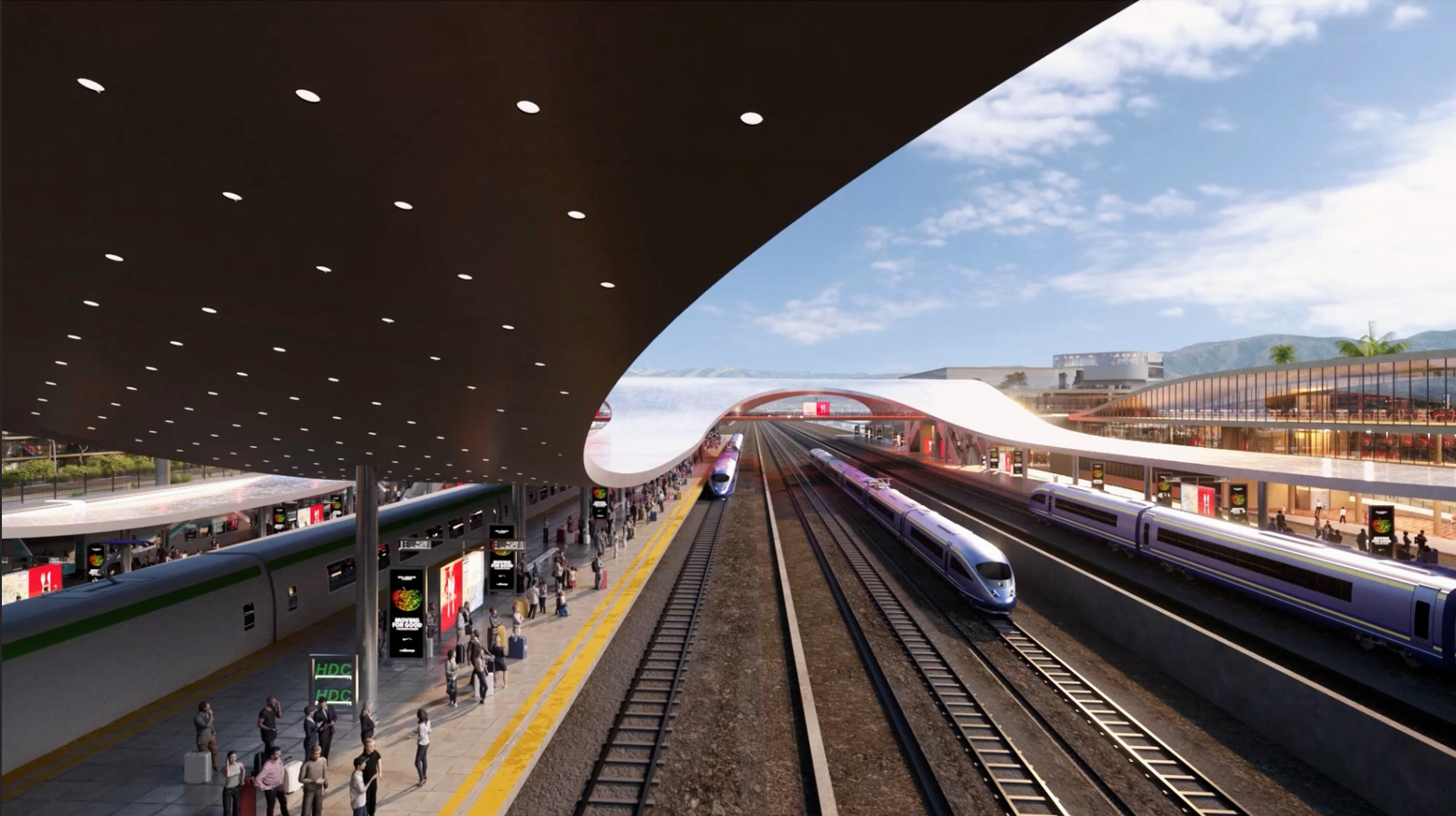
Two primary terminus stations are planned, for Palmdale and Victor Valley. The Palmdale Transportation Center is located to the west, on the edge of Los Angeles County, where it links to Metrolink's Antelope Valley Line to Burbank . Victor Valley Station is located in San Bernardino County where it connects to Brightline West.
Ridership projected to begin at 3.1 million riders annually, growing to 14 million per year by 2050.
.avif)