Illinois High-Speed Rail
284 miles
220 mph
2.5 hours
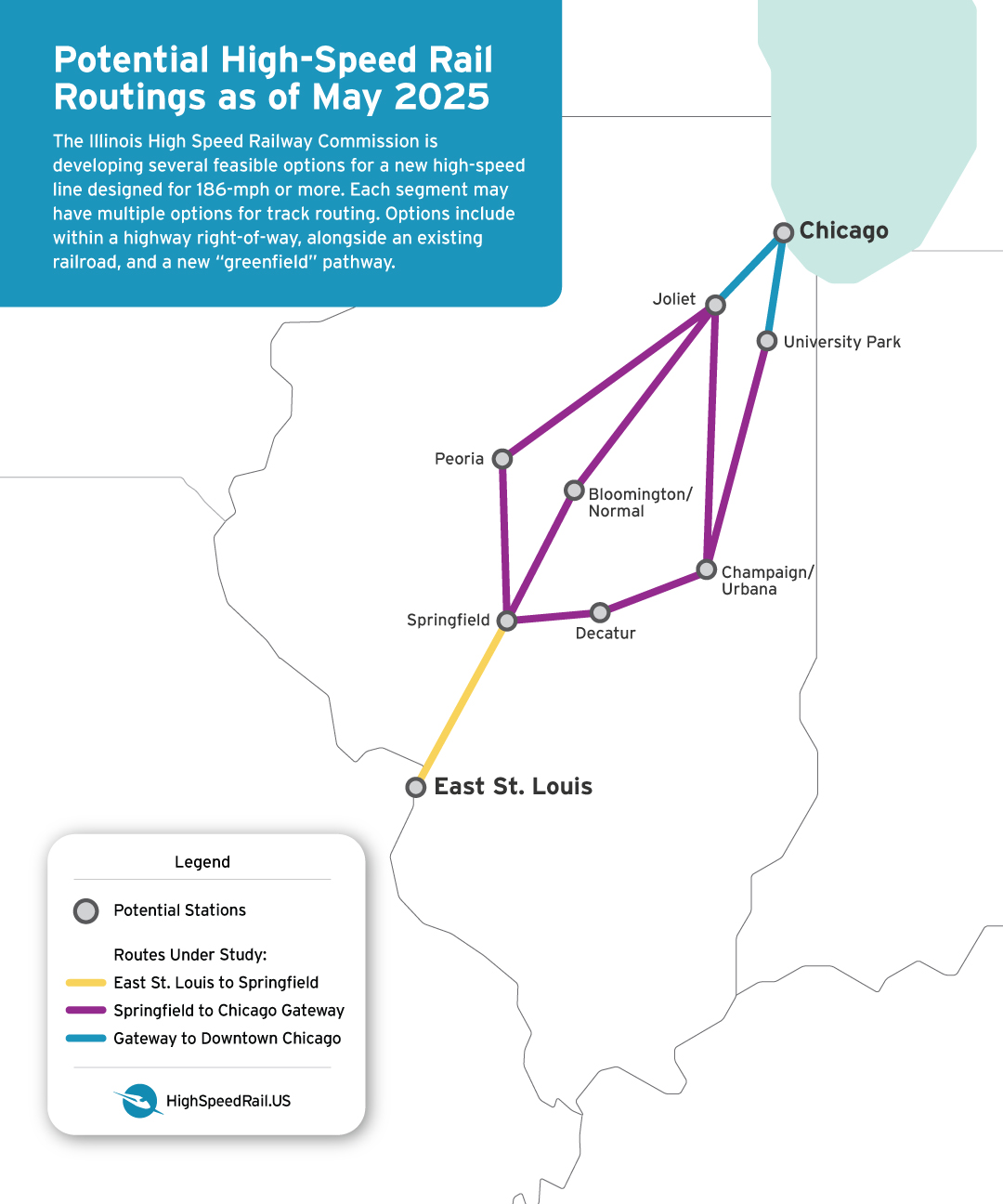
Illinois is leading the Midwest toward a connected high-speed rail future. Established by legislation signed by Governor J.B. Pritzker in 2021, the Illinois High-Speed Rail Commission is developing a statewide plan for a high-speed network that will connect Chicago and St. Louis.
The Commission is planning a high-speed backbone from Chicago to St. Louis, with a feeder rail and transit network serving smaller cities. The Commission has held public meetings on goals, design, and to engage stakeholders.
The Commission is nearly finished with an initial feasibility study, which will include route options, trip times, demand modeling and operating-cost estimates. It does not yet have an approved or funded high-speed rail construction project.
Chicago to St. Louis
Frequently Asked Questions
Chicago–St. Louis travel time could be cut in half, making high-speedrail a practical option for same-day business, university, government and leisure travel. Smaller cities such as Champaign–Urbana, Decatur and Springfield would gain fast access to both Chicago and St. Louis. And a larger integrated market would enable businesses to recruit across a wider region and give workers and others access to employment, education and services in neighboring cities without flying or making a long drive.
A University of Illinois study of 220 mph express service projected times from Chicago:
To Champaign-Urbana, 45 minutes; Springfield, 1 hour 18 minutes; St. Louis, about 2 and a half hours.
Ridership on Route 4, which has performed well in analysis due its fast trip times and strong Chicago, St. Louis and Champagne-Urbana demand, is projected at 2.82 million annual trips, increasing to 3.1 million annually by 2045. Other stations nearer to established urban centers would cost more but would be more convenient for many and ridership would be somewhat higher.